

TL;DR:
Running an IT function can be a mess. Access requests piling up as tickets, access reviews for the next SOC 2 audit, and people pinging you during lunch just to get into a tool. IGA (Identity Governance and Administration) tools were built to automate this. To control who has access to what, when it was granted, who approved it, and when it should be removed. The problem is that most IGA tools were built for large enterprises with a dedicated identity team.
If you're an early IT hire, you already know there's a better way than spreadsheets and manual tracking but you also know it may not be the right time to stand up a heavyweight enterprise suite with an enormous price tag that takes manpower just to maintain. We kept that in mind building this guide. The picks are sorted by the shape of the IT team running the tool.
In this blog:
Enterprise suites (SailPoint, Okta Identity Governance, ConductorOne, Lumos) are powerful and well-built for organizations with an identity team that can spend months deploying. Some require professional services just to go live.
Most of the enterprise tools automate only what's connected via SCIM/SAML, which is locked behind each app's enterprise tier. That "SSO tax" can inflate an app's price by 3x-10x or more (ssotax.org) and is the hidden cost that catches lean teams off guard.
An IGA for lean IT teams like AccessOwl can be stood up for a fraction of the cost. Enterprise rollouts run into the tens (or hundreds of thousands) of dollars which prices out many smaller teams.
What Is IGA (Identity Governance and Administration)?
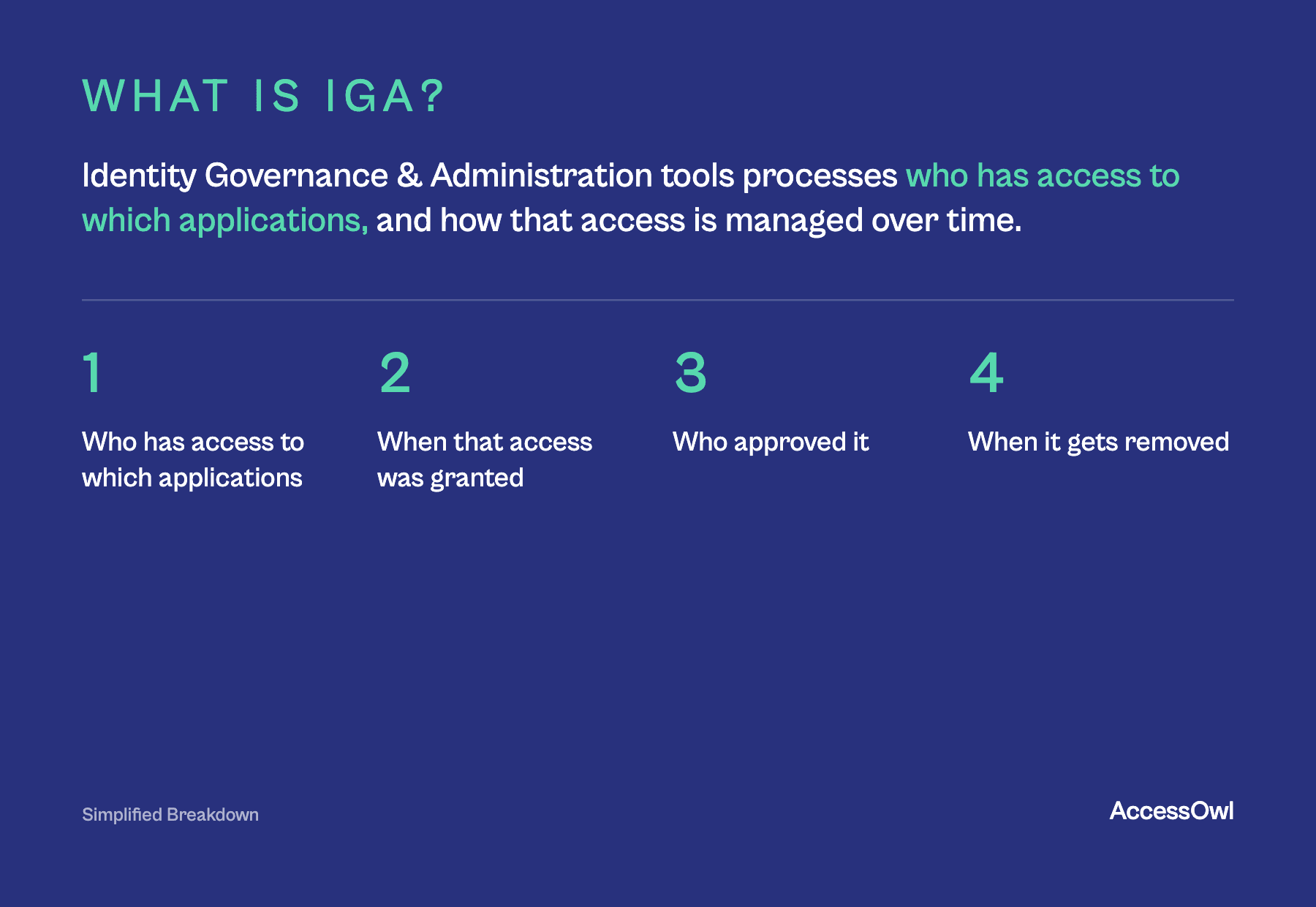
IGA (Identity Governance and Administration) is the set of tools and processes that govern who has access to which applications, when that access was granted, who approved it, and when it's removed.
At its core, IGA tools govern four things: (1) Who has access to which applications, (2) When that access was granted, (3) Who approved it, (4) When it gets removed.
A good IGA setup means you can point at any tool and say, with confidence exactly who's in it and why. An important step further that overwhelmed IT admins appreciate is the ability to automate this governance and administration. Grant access automatically when new hires join, revoke access to all apps when users leave, and have clean documentation for compliance frameworks like SOC 2.
Most teams start by managing Identity Governance with spreadsheets, Slack messages, and human memory. They feel it every time someone leaves or an audit lands.
"In one instance I found out that a former employee was still using a critical internal system 3 months after he left. I used to do manual checks to see whether users are still working with us once a month."
Source: Conversation with Khalifah Alsadah, Product Manager, Sary (600 employees, ~100 SaaS tools)
IGA v.s. IdP (Identity Provider)
Logging people in securely is your identity provider's job (Google Workspace, Microsoft Entra, Okta). IGA is what happens after login: granting the right access, proving it was approved, reviewing it on a schedule, and taking it away cleanly when someone leaves or changes roles.
How We Ranked These IGA Solutions
Every solution here was judged against the set of questions an IT manager asks during evaluation:
Does it automate provisioning and deprovisioning, or stop at authentication? Identity and access management is the job, not SSO.
What does coverage look like without enterprise-tier plans on SaaS apps? We weighted tools that avoid the SSO tax over those gating basic lifecycle behind SCIM upgrades.
How much setup and ongoing engineering time does it demand from a team of one?
Does it fit the our company stage, or is it built for a dedicated identity team that doesn't exist yet?
What does it cost to run in practice, including hidden upgrade paths?
Best IGA Solution for Small IT Teams: AccessOwl
If you are an early IT hire supporting 50 to 500 people, most identity governance tools were built for a buyer you are not yet. They assume a dedicated identity team, an enterprise SaaS portfolio, and a budget line that does not exist at your stage. AccessOwl was built for that gap. It sits on top of Google Workspace, Microsoft Entra, or Okta as a governance and automation layer, so you don't need a heavy migration.
While lightweight and built with non technical personnel in mind (HR personnel, line managers, non technical compliance owners) AccessOwl connects to 400+ SaaS apps. Customers reduce onboarding/offboarding tasks from two hours per user to less than 30 minutes per user.
What they offer
Access requests and approvals in Slack or a web dashboard: employees request where they already work; approvers act with a button click without opening separate tools.
Provisioning and deprovisioning without SCIM or SAML: Through agentic integrations that use the same admin APIs and interfaces your team already uses, so you're not forced onto enterprise plans to unlock automation.
Granular, permission-level provisioning: Put people in the right Slack user groups, the right roles and permission sets per app.
400+ SaaS connectors plus a way to cover the rest: For apps without a native connector, you can add them manually or connect them through public and custom APIs, and still track and manage them in one place.
Shadow IT discovery: Surfaces unmanaged apps and pulls them into offboarding, so access you didn't know about doesn't quietly stay live.
Access reviews: With audit-ready evidence export for SOC 2 and ISO 27001.
Who it's for
Lean IT teams (often one to five people) running Google Workspace, Microsoft Entra, or Okta, who want to automate identity governance work and satisfy compliance without a months-long project or a dedicated identity hire. AccessOwl is not meant to replace your identity provider. MFA and SSO stay managed by your IdP.
"The most impressive thing is how well the integration accounts work. It turned out to be pretty magical. I would recommend AccessOwl to any company that is growing. If you find yourself repeatedly thinking about granting users access to tools, this is a no-brainer." - Ethan Yu, Cofounder, Motion
Okta Identity Governance
Okta Identity Governance (OIG) is a paid add-on to Okta Workforce Identity Cloud (WIC), Okta's product for managing your own employees, not the customer identity product engineers embed in their apps. It extends an existing Okta environment with governance features and does not function as a standalone product.
What They Offer
Access request and approval workflows layered on top of your existing Okta connections
Access certification campaigns for Okta-connected applications
Entitlement management and separation-of-duties controls for enterprise governance programs
Who It's For
OIG is the logical choice when you are already all-in on Okta (use this guide on whether you need Okta to check), with near-complete WIC coverage, broad SCIM (System for Cross-domain Identity Management) and SAML (Security Assertion Markup Language) adoption, and a dedicated identity team to run a multi-month rollout. That is a genuinely correct buy for a mature enterprise identity program.
OIG governs only the apps already connected to Okta. Anything outside that set stays ungoverned unless you upgrade those apps to enterprise tiers to unlock the protocols, which is the Okta pricing and SSO tax showing up again at the governance layer.
Lumos
Lumos began as a governance layer built to sit on top of Okta, making access requests, reviews, and entitlement management feel more polished for the identity team running them. The company publicly targets organizations of 150 or more employees, so the product is shaped around a stack already standardized on enterprise identity protocols.
What They Offer
Access request workflows through an employee-facing app catalog
Automated provisioning and deprovisioning across Okta and SCIM-connected applications
Access certification campaigns with manager-led review flows
Compliance reporting aligned to SOC 2 (System and Organization Controls 2) and ISO 27001
Who It's For
Lumos fits enterprises already committed to Okta as their core IdP (Identity Provider) at 150 or more employees, with the maturity to support a governance layer on top. The limit is stated plainly by Lumos itself: it does not target companies under 150 people. Its automation ties to existing Okta and SCIM coverage, so if your stack has not standardized around enterprise protocols, the out-of-the-box automation only reaches apps that already speak them.
SailPoint
SailPoint is the legacy incumbent of enterprise IGA, built to manage identity across sprawling on-premises, hybrid, and cloud environments. Deployments are almost always consultant-led and run six to twelve months before they go fully live.
What They Offer
Role mining that analyzes access patterns and recommends automated provisioning roles
Identity lifecycle management across on-premises directories, cloud infrastructure, and SaaS apps
Separation of duties (SoD) enforcement and certification workflows for compliance-driven industries
A broad connector library spanning legacy systems, ERPs, and cloud applications
Who It's For
SailPoint fits large enterprises in compliance-heavy sectors like financial services, healthcare, and government, where thousands of identities span hybrid systems and the budget and staffing for a full rollout already exist. That is a very different context from the workflows Okta doesn't solve that smaller teams face.
The limitation is delivery. Implementations lean on vendor or partner professional services across a six to twelve month timeline, with services costs that can match or exceed the license itself. For a lean IT team at a growth-stage company, that overhead is not viable.
ConductorOne
ConductorOne was built for access governance on top of an existing identity architecture, primarily Okta plus broad SCIM and SAML coverage. It gives security and compliance teams request approvals, reviews, and entitlement governance.
What They Offer
Access request and approval workflows integrated with existing Okta environments
Access certification campaigns with configurable review policies
Entitlement visibility across SCIM-connected applications
Compliance evidence for SOC 2 and ISO 27001 audits
Who It's For
ConductorOne fits organizations of 300 or more employees with mature Okta deployments, dedicated security and compliance teams, and enterprise plan coverage across the stack.
The limitation is inherited: because the governance layer depends on pre-existing SCIM and SAML, any app that never adopted those protocols stays outside automated provisioning and deprovisioning.
Zluri
Zluri was built as a SaaS management tool first, with governance layered on top. Its founding job is visibility and spend: find every app in your stack, track what you pay, and reclaim unused licenses. IGA (Identity Governance and Administration) capabilities extend that base for teams wanting centralized control over a sprawling SaaS environment.
What They Offer
A discovery engine (AuthKnox) that surfaces sanctioned and Shadow IT in SaaS environments, then automates onboarding, access reviews, and license management
SaaS spend tracking, license optimization, and contract renewal management
Access controls mapped to SOX, HIPAA, and SOC 2 (System and Organization Controls 2) requirements
Provisioning and deprovisioning that reaches non-SCIM and unfederated apps
Who It's For
Zluri fits mid-market teams wanting a SaaS-first governance tool with strong discovery, without standing up an enterprise deployment. If your primary pain is knowing what you own and what it costs, Zluri answers that first.
Feature Comparison Table of IGA Solutions
Here is how the six solutions line up on the features that actually separate them. On the enterprise-plan row, "Partial" means the vendor supports some non-SCIM provisioning, but coverage is uneven across integrations, so parts of your stack still fall back on manual work or upgraded plans. HRIS refers to your Human Resources Information System, the system of record that fires the start-date and last-workday events lifecycle automation depends on.
Feature | AccessOwl | Okta Identity Governance | Lumos | SailPoint | ConductorOne | Zluri |
|---|---|---|---|---|---|---|
Enterprise SaaS license upgrades required | No | Yes | Yes | Yes | Yes | Partial |
HRIS-triggered onboarding and offboarding | Yes | No | Yes (Okta-dependent) | Yes | No | Yes |
Shadow IT discovery | Yes | No | No | No | No | Yes |
Viable for teams under 150 employees | Yes | No | No | No | No | Yes |
Deployment heaviness | Live within a week, even by non-technical staff | Identity team running a full-time project | Identity team running a full-time project | Identity team running a full-time project | Identity team running a full-time project | Dedicated ongoing administration |
Comparing the cost of IGA tools (the hidden SSO tax)
Most enterprise IGA tools automate through SCIM and SAML, and those protocols are gated behind each app's enterprise tier. A proper cost analysis needs to count these required SaaS upgrades. Take three tools almost every team uses, and just the jump to the tier that unlocks SSO/SAML (per the publicly sourced SSO Wall of Shame):
App | Base plan | Plan with SSO/SAML | Increase | Extra/user/mo | Extra/yr (100 users) |
|---|---|---|---|---|---|
Slack | $7.25/user/mo | $12.50/user/mo | +72% | +$5.25 | +$6,300 |
Notion | $8/user/mo | $15/user/mo | +88% | +$7.00 | +$8,400 |
Linear | $10/user/mo | $15/user/mo | +50% | +$5.00 | +$6,000 |
Total | ~$20,700/yr |
For a full stack the difference in price of the two approaches may look like this:
Approach A - Lightweight IGA (e.g. AccessOwl on top of Google Workspace). Provisioning runs through agentic integrations on the plans you already pay for. Yearly cost with 100 employees ($10,200), required SaaS upgrades ($0).
Approach B - Enterprise IGA suite (example: an Okta-style, SCIM-dependent suite). Yearly cost with 100 employees ($20,400), required SaaS upgrades ($200,000+).
The full breakdown of this scenario in our Okta breakdown.
Final Thoughts on Picking the Right IGA Tool for Where You Are Now
Most IGA buying decisions go wrong because the buyer is comparing features instead of comparing contexts. SailPoint is a genuinely well-built product. So is Okta Identity Governance. Neither was built for the IT team of one supporting 80 people on Google Workspace, and no amount of features changes that mismatch. Figure out your team size, your IdP, and how much setup time you can realistically absorb, and the right tool becomes fairly obvious. Scan your access environment to see what you're actually working with before you run your assessment.
FAQ
How do I choose the right IGA solution when my team is under 150 employees?
Start with your existing infrastructure and team capacity. If you run Google Workspace or Microsoft Entra and have no dedicated identity headcount, tools built around SCIM and SAML (such as Okta Identity Governance, Lumos, or ConductorOne) require enterprise-tier upgrades across your stack before automation kicks in. If you are at 50 to 150 employees without those upgrades already in place, AccessOwl or Zluri are the only options in this list that automate provisioning without forcing that spend.
Is AccessOwl better than SailPoint or ConductorOne for a 100-person startup?
Yes, for that specific profile. SailPoint and ConductorOne were built for organizations with dedicated identity teams, six-to-twelve month implementation budgets, and enterprise-tier SaaS coverage already in place. At 100 people, you almost certainly have none of those. Both tools assume a structural maturity that takes years to build, and neither is designed for a single IT hire running provisioning alongside everything else.
When does Okta Identity Governance become the right buy over AccessOwl?
When Okta Workforce Identity Cloud already covers most of your stack, your applications are broadly on enterprise tiers with SCIM active, and you have a dedicated identity team to run a multi-month rollout. OIG governs only applications already connected to Okta, so its value scales directly with how complete your existing Okta deployment is. If that describes your environment, OIG is a logical extension. If it does not, you are paying for governance that only reaches a fraction of your tools.
What is the SSO tax, and why does it matter when comparing these IGA solutions?
The SSO tax is the cost of upgrading SaaS applications to enterprise tiers to unlock SCIM and SAML, which most IGA tools require before automated provisioning works. Tools like Okta Identity Governance, Lumos, ConductorOne, and SailPoint all depend on those protocols being active. Across even a modest SaaS stack, those upgrades can exceed $100,000 annually before you factor in the IGA license itself. AccessOwl avoids this by using service accounts and browser automation to provision apps that never get enterprise-tier upgrades.
Does Zluri or AccessOwl handle Shadow IT discovery better for a mid-market team?
They approach it from different starting points. Zluri was built as a SaaS spend and discovery tool first, so its discovery engine is core to the product. AccessOwl's discovery pulls from OAuth logs and invitation-email scanning, and its defining advantage is what happens at offboarding: every identified application tied to a departing employee surfaces automatically for closure, which Zluri does not match at the lifecycle-automation layer. If your primary pain is knowing what you own and what it costs, Zluri fits first. If your primary pain is offboarding completeness and compliance evidence, AccessOwl fits first.
What's the best identity governance tool for teams on Google Workspace?
For teams running Google Workspace, AccessOwl is the strongest fit. It sits on top of Google Workspace as a governance and automation layer. Google Workspace keeps handling login, MFA, and SSO while AccessOwl handles account provisioning, routing approvals, access reviews, and cleanly removing access when someone leaves. Because it provisions through integration accounts rather than relying on SCIM or SAML you get automation across 400+ SaaS apps without paying the enterprise-tier "SSO tax" on every tool.