
Okta sells two completely different products under the same brand. Okta Workforce Identity Cloud (WIC) manages your employees' access to company apps. Okta Customer Identity Cloud (CIC) manages login flows for your product's end users. It's the rebranded Auth0 after the 2021 acquisition. Different buyers (IT vs. engineering), different problems (internal access vs. customer signups), different budgets. Most people assume one Okta license covers both. That assumption wastes money. This post focuses on WIC, the workforce side, because that's where the "do I need Okta?" question lives for most IT teams.
TLDR:
Okta sells two separate products: Workforce Identity Cloud (WIC) for employee access and Customer Identity Cloud (CIC) for customer logins in your product.
WIC handles SSO and authentication but SCIM provisioning only covers 15-25% of your SaaS stack, leaving 75-85% manual.
The SSO tax forces SaaS plan upgrades from $15 to $50+ per user just to activate SAML, often costing more than the identity layer itself.
AccessOwl automates provisioning across 400+ apps without requiring enterprise SCIM contracts, working on top of your existing IdP.
The Core Confusion: Okta Is Two Different Products
Walk into any room of IT admins and ask what Okta does, and you'll get a confident answer: single sign-on, user management, the identity layer your company runs on. That answer is half right.
Okta sells two separate products under the same brand. They share a logo and a marketing site, and almost nothing else. Different buyers, different price sheets, different feature sets, different competitors.
The two products, plainly
Okta Workforce Identity Cloud (WIC): identity infrastructure for your own employees and contractors. SSO (single sign-on), MFA (multi-factor authentication), lifecycle management, and governance for the apps your staff log into. The buyer is IT or security.
Okta Customer Identity Cloud (CIC): identity infrastructure you embed inside your own product so your customers can sign up and log in. This is the rebranded Auth0, which Okta acquired in 2021. The buyer is engineering.
If you're an IT lead at a 120-person startup wondering whether to roll out Okta, you're looking at WIC. If you're a backend engineer wiring up login screens for your SaaS app, you're looking at CIC. The two teams will rarely meet, and they will rarely need the same thing.
Dimension | Workforce Identity Cloud (WIC) | Customer Identity Cloud (CIC / Auth0) |
|---|---|---|
Who logs in | Your employees and contractors | Your product's end users |
Primary buyer | Head of IT or security | CTO or VP of Engineering |
Daily operator | IT admin in a console | Backend engineer in code |
Budget owner | IT | Engineering / product |
Pricing model | Per employee | Per monthly active user (MAU) |
Core jobs | SSO, MFA, lifecycle, governance | Signup, social login, passwordless, B2B SSO |
Optimizes for | Control and audit readiness | Conversion and developer velocity |
Lives in | Your admin console | Your codebase |
Typical competitors | Google Workspace, Microsoft Entra, AccessOwl (governance layer) | Auth0, WorkOS, Stytch, FusionAuth |
KPIs | Audit pass rate, time to provision/revoke | Signup conversion, login success, p95 auth latency |
Why the confusion sticks
The branding does most of the damage. Auth0 was a beloved developer tool before the acquisition, and Okta folded it under the Okta name without retiring the underlying product. The Auth0 community itself fields the question constantly, with Auth0 experts explaining the split to customers who assumed one license covered both jobs.
A second source: both products deal with "identity," so a casual reader assumes overlap. They don't. Workforce Identity manages the people on your payroll. Customer Identity manages the people who pay you. The directories are separate, the policies are separate, and the compliance posture you need for each is separate.
Why this matters before you read further
The rest of this piece is about WIC. AccessOwl sits in the workforce identity stack as a governance and automation layer, and that's the world where the "do I need Okta?" question gets asked. CIC is a different conversation with different trade-offs and competitors, and we'll cover it in its own section so you can tell which problem you actually have.
Okta Workforce Identity Cloud: Managing Employee Access
Workforce Identity Cloud is the product your IT team logs into. The job it does, in one sentence: be the single source of truth for which employee can access which company app, and prove it.
What WIC delivers day to day
A central directory of employees, contractors, and service accounts (often synced from an HRIS or used as the primary directory itself).
SSO across every connected SaaS app, so an employee signs in once and lands inside Salesforce, Jira, Slack, and the rest without re-entering passwords.
MFA enforcement and conditional access policies (block logins from unmanaged devices, step up auth from new locations, require a hardware token for admin roles).
Lifecycle management through SCIM (System for Cross-domain Identity Management): when HR marks someone as hired, WIC provisions the apps; when they're terminated, WIC suspends the identity.
A self-service app dashboard for employees and an audit log for the IT team.
Reporting hooks for SOC 2 and ISO 27001 evidence.
Who's actually clicking around in WIC
The buyer and the daily operator are usually the same person at a 50 to 300 employee company: whoever owns IT. That might be a Head of IT with a real title, or it might be the Chief of Staff, a CTO doubling as an admin, or the first security hire. They care about three things in this order: passing the next audit, killing manual onboarding tickets, and keeping the bill predictable.
WIC handles the first two reasonably well at the authentication layer. The catch is reach. SSO and SCIM only work for apps that support them, which in practice means apps on enterprise-tier plans. The directory side is strong; coverage breadth depends on what your vendors expose.
Where WIC sits in the stack
Think of WIC as the gate, the badge reader, and the timecard rolled into one. It decides whether you can walk into an app, what identity you present when you do, and when your badge stops working. HRIS systems feed it upstream; connected SaaS apps consume identities downstream. In most deployments, WIC is the company's primary IdP (Identity Provider), and everything else in the access stack assumes it's already in place.
Okta Customer Identity Cloud: Authenticating Your Product's Users
Customer Identity Cloud lives in your codebase, not your admin console. When your engineering team ships a signup form, a "Log in with Google" button, or a passwordless magic link, CIC (still branded Auth0 in most documentation) is what sits behind it. The product your customers use becomes the consumer of identity, and your developers are the ones wiring it up.
What CIC actually does for developers
SDKs (Software Development Kits) and APIs for every major language, so a backend engineer can drop authentication into a Node, Python, or Go service in an afternoon instead of writing OAuth flows from scratch.
Social login connections for Google, Apple, GitHub, Facebook, and other providers, configured through a dashboard instead of per-provider integration work.
Passwordless options (magic links, SMS codes, WebAuthn) for products where a password form would tank signup conversion.
A hosted Universal Login screen you can theme to match your product, plus the option to host your own UI and call the API directly.
B2B features like organizations, tenant isolation, and SSO connections into your customers' own IdPs, so an enterprise buyer can log into your product through their corporate Okta or Entra.
Rules and Actions (server-side code triggered during login) for custom logic, fraud checks, and data enrichment.
Why this is a build-vs-buy decision, not an IT purchase
A finance lead does not pick CIC. An engineering lead does, and the choice on the table is "should we build this ourselves?" Teams that try the build route underestimate the long tail: password resets, account recovery, session management, OAuth refresh tokens, brute-force protection, audit logs for regulators, GDPR (General Data Protection Regulation) deletion endpoints, and the on-call burden when login breaks at 2am. CIC exists because that surface area is larger than it looks.
Why the UX requirements diverge from WIC
Workforce identity optimizes for control: conditional access, hardware tokens, blocked devices, forced password rotation. Customer identity optimizes for the opposite, because friction kills conversion. A B2C signup flow that asks for MFA on the first screen loses signups. A B2B login that does not federate to the customer's IdP loses deals. CIC's defaults reflect that, with progressive profiling, social login by default, and the option to delay strong auth until a sensitive action warrants it.
Authentication vs Authorization: Why the Distinction Matters
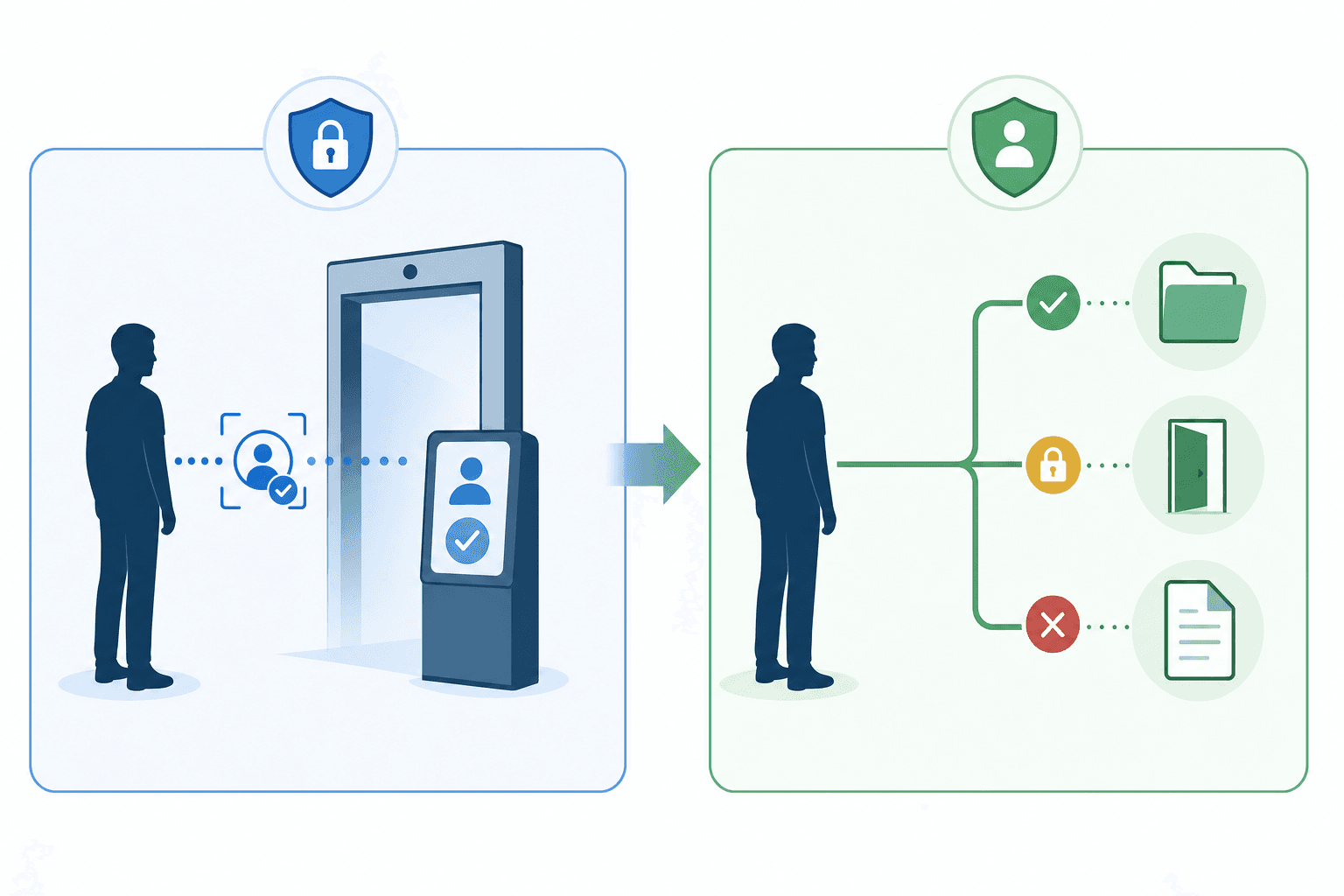
Authentication vs. authorization: who you are vs. what you can do. Vendor marketing bundles the two together, and that bundling is part of why buyers misjudge what they're buying.
The protocols, split by job
SAML (Security Assertion Markup Language) and OIDC (OpenID Connect): authentication protocols. When a user clicks "Log in with Okta," SAML or OIDC carries the assertion that this person is who they claim to be, then hands the session back to the app.
OAuth 2.0: an authorization framework, most often used to delegate API access (the "Log in with Google" pattern uses OIDC built on top of OAuth). It grants scoped tokens, not user identities.
SCIM (System for Cross-domain Identity Management): the provisioning protocol. It creates, updates, and deactivates user records inside a SaaS app, and it carries the group memberships and role attributes the app reads to make authorization decisions.
SCIM and SAML serve different roles: SAML is the door and SCIM is the filing cabinet behind it.
How WIC covers both layers for employees
For workforce use, Okta WIC runs the full stack. SAML or OIDC handles login. SCIM pushes the user into each connected app with group memberships, which the app reads to decide whether someone can edit a Salesforce opportunity, merge a pull request, or see the finance folder in Google Drive. The authorization decision still happens inside each app, but WIC feeds the inputs.
The catch is familiar: SCIM only goes as deep as the app exposes. Many apps accept a SCIM user record but reject group assignments, leaving the authorization layer half done. The user exists; permissions still get set by hand.
Why CIC usually stops at authentication
Customer Identity assumes something different. Your product has its own authorization model, encoded in your database with tables for roles, plans, tenants, and feature flags. CIC verifies the user and hands your backend a token with claims attached. Your application code decides what the user can see and do.
CIC can carry custom claims and roles in the token, and B2B organizations help with multi-tenant logic, but entitlement rules live in your product. The login layer says "this is Jane at Acme Corp." Your code decides whether Jane can delete the workspace.
Who Actually Uses Each Product?
The buyer profiles for these two products sit in different orgs, report to different executives, and answer to different metrics. That is the structural reason this confusion costs money: when a CTO greenlights "Okta" thinking the company is buying one thing, the IT lead and the engineering lead can each end up with the other person's product.
WIC stakeholders
The people in the room for a Workforce Identity Cloud purchase look like this:
Economic buyer: CIO, COO, or a CTO acting as cost owner, signing off on a per-employee SaaS bill that compounds with headcount.
Technical owner: Head of IT, IT Manager, or the involuntary IT admin (Chief of Staff, first security hire, a CTO doubling up). They run the rollout and live in the admin console.
Influencers: the compliance owner preparing for SOC 2 or ISO 27001, and the security lead worried about offboarding gaps.
KPIs they track: audit pass rate, mean time to provision a new hire, mean time to fully revoke a leaver, ticket volume from access requests.
WIC buyers care about employee productivity and audit readiness, not product growth.
CIC stakeholders
The Customer Identity Cloud buying committee almost never overlaps with the one above:
Economic buyer: CTO, VP of Engineering, or a product-line GM with a build-vs-buy budget.
Technical owner: a backend engineering lead, a platform engineer, or an application security engineer who owns the login surface in the product.
Influencers: a product manager who cares about signup conversion, a sales engineer pushing for enterprise SSO so deals close, a privacy or legal lead worried about GDPR deletion flows.
KPIs they track: signup conversion rate, login success rate, time to ship enterprise SSO for a six-figure deal, p95 latency on the auth endpoint.
FusionAuth's comparison of CIAM and IAM makes the same split from the developer side: CIC lives next to product engineering because the auth surface is part of the product.
Why the budgets do not compete
WIC is paid out of an IT or G&A budget and scales with headcount. CIC is paid out of an engineering or product budget and scales with monthly active users of your product. A company that needs both buys both, through different procurement workflows. The damage shows up when one team assumes the other's contract covers their problem, and the renewal cycle reveals a gap nobody owned.
Common Use Cases: When You Need Workforce Identity
Workforce Identity earns its keep in specific situations. Not every 60-person company needs it; some 200-person companies still don't. The signal is the shape of the problem, not headcount alone.
1. You're running 30+ SaaS apps with overlapping user bases
Once a company is paying for Salesforce, Jira, GitHub, Notion, Figma, 1Password, Datadog, and another two dozen tools, password fatigue stops being a UX complaint and starts being a security incident waiting to happen. A central login layer with one set of strong credentials and one MFA prompt cuts the attack surface and helpdesk volume in the same move. Most teams hit this threshold between 50 and 150 employees, when shared logins and recycled passwords stop being containable.
2. Your SOC 2 or ISO 27001 audit is on the calendar
Quarterly access reviews, evidence of provisioning controls, and a documented joiner-mover-leaver process are no longer optional for companies selling into mid-market or enterprise. A workforce identity layer gives auditors a single artifact to inspect instead of asking each tool owner for screenshots. The audit lift drops sharply once provisioning and review evidence live in one workforce IAM system.
3. Onboarding and offboarding are eating Friday afternoons
Manual onboarding breaks somewhere around 20 employees. By 50, it's a part-time job. By 150, it's a full-time one. Workforce Identity automates the joiner side (HRIS triggers the right template, the right apps get the right roles) and, more importantly, the leaver side, where missed accounts become orphaned accounts and orphaned accounts become breach reports.
4. You need policy-based access control, not goodwill
Conditional access (block logins from unmanaged devices, require a hardware token for admin roles, step up auth for sensitive actions) is impossible to enforce app by app. Oloid's overview of workforce IAM lays out the device-trust and location-aware patterns that only work when one system holds the policy and every app trusts that system's verdict.
A quick decision filter
Workforce Identity is likely the right investment if three of the following are true:
50+ employees, with hiring ahead of you.
25+ SaaS apps in regular use.
An audit framework (SOC 2, ISO 27001, HIPAA) in scope this fiscal year.
An IT or security owner who can run the rollout, beyond just signing the contract.
Apps in your stack that already support SSO and SCIM on a tier you can afford.
If you can check fewer than three, the gap is usually automation, not authentication, and the spend should go somewhere else first.
Common Use Cases: When You Need Customer Identity
Customer Identity earns its keep when the login screen is part of the product you sell. The decision sits with engineering and product, gets reviewed against signup funnels and enterprise deal cycles, and rarely shows up in an IT roadmap at all.
1. You're shipping a product that has end users
If your application has a signup form, a "forgot password" link, or a session that survives a browser restart, you have a customer identity problem. Building it in-house is fine for a month, until password resets, account recovery, suspicious-login alerts, and refresh-token rotation start eating a backend engineer's week. CIC exists so that engineer can ship features instead.
2. You expect scale that breaks a homegrown solution
B2C products optimizing for signup volume hit problems workforce stacks never see: bot signups, credential stuffing, password sprays, account takeover at the edges of a marketing campaign. Customer identity systems are sized for orders of magnitude more users than workforce ones, with the rate limiting, fraud signals, and elastic infrastructure to match.
3. Social and passwordless login affect conversion
If your signup funnel competes with consumer apps, "Continue with Google" or a magic-link flow is table stakes. Wiring up each provider directly is doable; keeping the integrations alive as Apple, Google, and Meta change their consent flows is the part teams underestimate. CIC bundles those connections behind one config.
4. Enterprise customers want to log in through their own IdP
B2B SaaS hits a moment where a prospect says "we need SSO into your product through our Okta tenant" and the deal stalls until you can say yes. Curity's overview of IAM vs CIAM frames this as the moment a product crosses from consumer to enterprise: federation into customer IdPs becomes a sales requirement, not a feature request.
5. The login screen needs to look like your product
A generic vendor login page at the front door of a paid product chips at trust on every visit. CIC ships with theming, custom domains, and a hosted UI you can override.
A quick decision filter
CIC (or a competitor like Auth0, FusionAuth, Stytch, or WorkOS) is likely the right buy if three of the following are true:
Your product has external users who are not on your payroll.
Signup volume is high enough that conversion math matters.
An enterprise prospect has asked for SSO federation into their IdP.
Your roadmap includes social login, passwordless, or MFA for customers.
The build-vs-buy meeting has already happened once and stalled on scope.
If fewer than three apply, engineering can defer. If three or more, the question is which CIAM (Customer Identity and Access Management) vendor, not whether to buy one.
The SSO Tax Problem and Why It Matters for This Decision
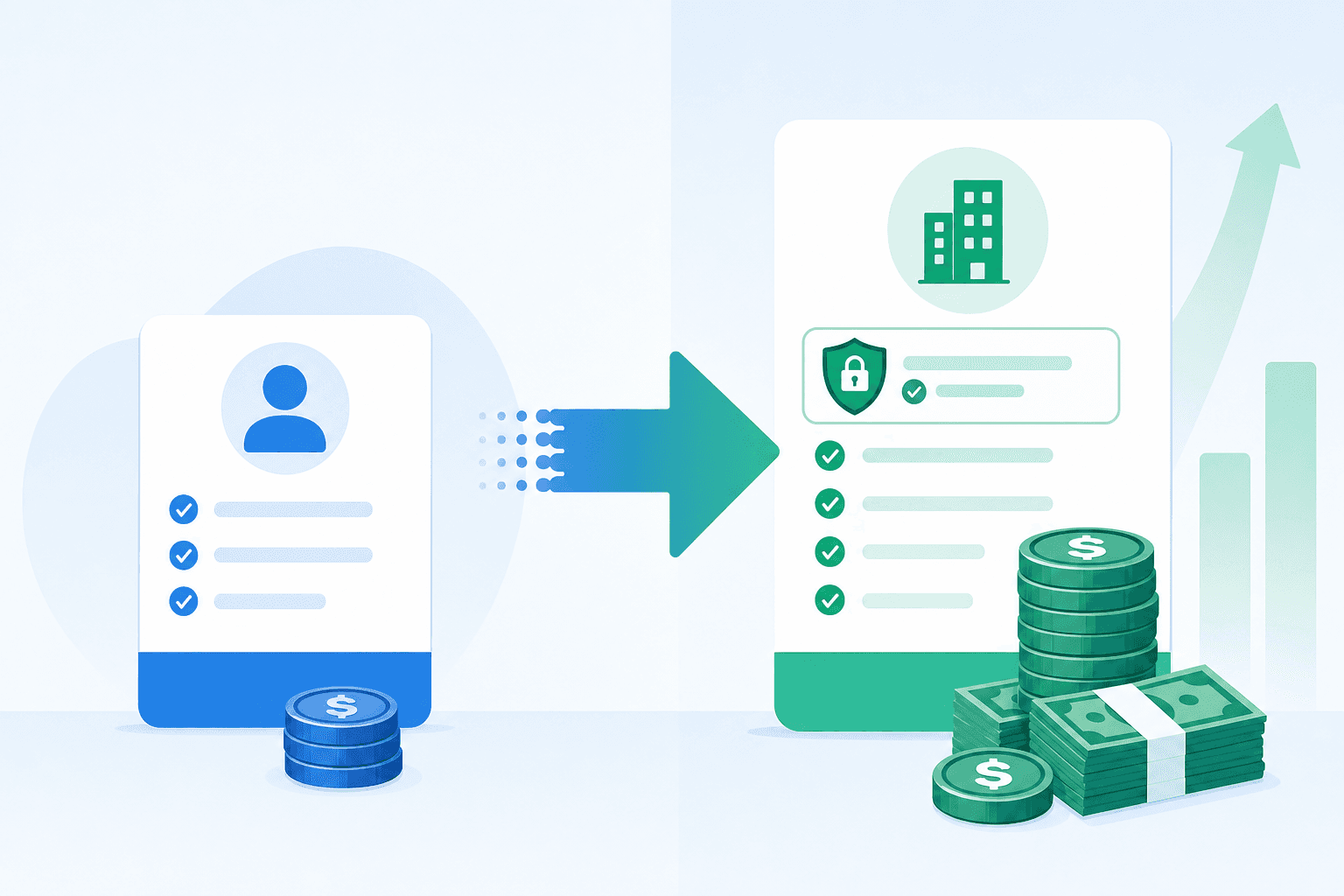
The "SSO tax" is the surcharge SaaS vendors apply when you ask for SAML or SCIM. Same software, same seats, but the line item to turn on federation jumps you from a $15/user plan to a $50/user enterprise plan, sometimes more. The IT community has been tracking the SSO tax pattern for years, and the takeaway is uncomfortable: a basic security control gets priced like a luxury feature.
This matters for the WIC vs CIC decision because the SSO tax is what makes Workforce Identity feel mandatory before it actually is.
How the math turns ugly
A typical sub-200-person company runs 80 to 150 SaaS apps. Plenty of those tools sit on the cheapest plan that does the job. The moment IT decides to put Okta WIC in front of them, the question stops being "is Okta worth it?" and starts being "is the enterprise upgrade cost worth it?" The license fee for the identity layer is usually the smaller line on that invoice.
Per-seat upgrades of 3x to 10x are common when adding SSO, and they cluster on tools that lack an obvious champion to cover the spend.
The coverage gap nobody talks about
Most employee-used SaaS apps sit outside any SSO portal. They remain unintegrated because the vendor charges more for SAML than the team using the tool pays in total subscription cost. So they stay outside the perimeter, with shared logins, sticky-note passwords, and no audit trail.
Why this reframes the WIC vs CIC question
If you confuse the two products and assume buying "Okta" solves access management end to end, you end up paying for WIC plus a long tail of enterprise upgrades, and still cover only the 20% of apps that fit the model. CIC has nothing to do with that problem. It lives in your product, not your stack, and the SSO tax does not apply to it at all.
For some buyers, paying the tax and standardizing on WIC is the right call. For most sub-200-person teams, knowing which product you actually need is the cheapest way to avoid funding a federation layer for tools that will never sit behind it.
What Happens When Companies Choose WIC For the Wrong Reasons
A 70-person company on Google Workspace decides "we should get Okta." The audit is six months out, onboarding is chaotic, offboarding is worse. They sign a WIC contract, scope a three-month rollout, and start the SaaS-tier upgrades. Six months later, SSO works for the eight apps that made the cost cut, the audit still requires manual evidence for the other 40, and onboarding tickets have moved from the IT inbox to a different IT inbox. The diagnosis was right (access is broken) and the prescription was wrong (the gap was provisioning automation, not authentication).
How AccessOwl Fits Into the Workforce Identity Stack
Everything above sits inside the Workforce Identity conversation, which is where we work. AccessOwl is a governance and automation layer that runs on top of whatever IdP you already have: Google Workspace, Microsoft Entra, or Okta WIC. We do not issue credentials, run SSO, or enforce MFA. Those jobs stay with your IdP.
What we do is close the provisioning gap SCIM leaves behind. SCIM typically reaches 15 to 25 percent of a SaaS stack, gated by which vendors expose it on a tier you can afford. The remaining 75 to 85 percent gets handled manually, in tabs, by whoever drew the short straw. We connect to 400+ applications through service accounts, OAuth, available APIs, and browser automation for apps that offer none of the above, then run the same joiner-mover-leaver flows across all of them without requiring enterprise SCIM contracts.
Where we sit on the WIC vs CIC question
We compete only with the governance and lifecycle portion of Okta WIC, not SSO, not MFA, not conditional access.
We do not compete with CIC or Auth0 in any form. Customer identity is a different product for a different buyer.
We fit 20 to 300+ employee companies whose real gap is automation, not authentication, and who do not have a dedicated identity team to run a full Okta rollout.
If you already run Okta WIC, we extend it across the apps SCIM never reaches. If you run Google Workspace or Entra as your IdP, we handle governance without forcing a migration.
Final Thoughts on Okta's Workforce and Customer Identity Divide
The brand says Okta, but the products are WIC and CIC. You're either managing employee access or building login screens for customers, rarely both at once. If you're in the workforce camp and realize SCIM covers less than a quarter of your apps, let's talk about automating the rest without enterprise upgrades. Clarity on which problem you have is half the work of solving it.
FAQ
What's the main difference between Okta Workforce Identity and Customer Identity?
Workforce Identity Cloud (WIC) manages your employees' access to company apps (SSO, MFA, provisioning), while Customer Identity Cloud (CIC, formerly Auth0) handles login flows for your product's end users. Different buyers (IT vs. engineering), different price models (per-employee vs. per-MAU), and different feature sets built for entirely separate use cases.
Can I use Okta Workforce Identity without requiring enterprise-tier SaaS plans?
Not fully. Okta WIC relies on SCIM and SAML to automate provisioning, and most SaaS vendors gate those protocols behind enterprise plans that cost 3x to 10x more than standard tiers. SCIM typically covers only 15-25% of a company's SaaS stack, leaving the remaining 75-85% requiring manual provisioning or alternative automation approaches that bypass the SSO tax.
Okta WIC vs CIC pricing models?
WIC bills per employee or contractor in your company directory and scales with headcount, typically paid from an IT or G&A budget. CIC bills per monthly active user (MAU) of your product and scales with your customer base, paid from an engineering or product budget. The two contracts don't overlap, and a company needing both buys both through separate procurement workflows.
When does it make sense to invest in Workforce Identity?
When at least three of these apply: 50+ employees with hiring ahead, 25+ SaaS apps in regular use, an audit framework (SOC 2, ISO 27001, HIPAA) in scope this fiscal year, an IT or security owner who can run the rollout, and apps that already support SSO and SCIM on tiers you can afford. Below that threshold, the gap is usually automation, not authentication.