
Modern HRIS tools like BambooHR handle part of onboarding and offboarding through your identity provider. Connect BambooHR to Google, and a start date creates the Google accounts and permissions needed for that new hire. That covers roughly half of the tools a team actually uses.
The rest of the stack still lands on whoever owns IT. BambooHR knows a support contractor starts Monday. It has their paperwork signed and their checklist ready. What it will not do is put them into Slack, Zendesk, and your internal tools. That often stays manual, one admin console at a time.
To solve this, you can lean on SCIM based provisioning from your IdP (Google, Microsoft Entra, Okta). Or you can use SaaS lifecycle automation tools that integrate with BambooHR, such as AccessOwl. Teams often choose AccessOwl to avoid the the SSO tax that would come with the provisioning from your IdP tools. You need to upgrade each app to an enterprise tier just to switch on SCIM. Turning this on for one app like Asana runs from $25 to $60 per user per month.
In this blog:
SaaS provisioning with BambooHR's native features
Automating onboarding and offboarding with BambooHR + AccessOwl
SaaS provisioning with BambooHR & do-it-yourself automation (scripts, API connectors, spreadsheets)
Method 1 - SaaS provisioning with BambooHR alone
What BambooHR handles on its own
BambooHR is your system of record: each person's role, team, department, location, manager, and their start and end dates. On onboarding it does real work. It sends new-hire packets, collects documents, handles e-signatures on offers and tax forms, runs I-9 and E-Verify, and keeps one central record.
It also fires onboarding and offboarding checklists: task templates with due dates, assignees, and reminders. That includes the task telling IT to set up a new person's accounts. For a growing company, it runs the HR half of onboarding and offboarding well.
Does BambooHR provision third party SaaS accounts?
BambooHR won't create or delete accounts in your third-party SaaS apps. To reach them you have two options: set up SCIM or SAML provisioning through your IdP (Okta, Entra, or Google). Alternatively, add a tool like AccessOwl that provisions across your whole stack without SCIM or SAML.
BambooHR does not create or delete accounts in Slack, Zendesk, Notion, or the dozens of other tools your team uses. It has no SCIM or SAML to reach them, and no way to see Shadow IT.
"HRIS tools get you to maybe 50%, basically deactivating the Microsoft and Google accounts. If you want the full package and offboard people from every SaaS app, you'll likely need something extra on top, like an access governance tool."
Philip Eller, Cofounder, AccessOwl
Why teams add a dedicated access management tool on top of BambooHR
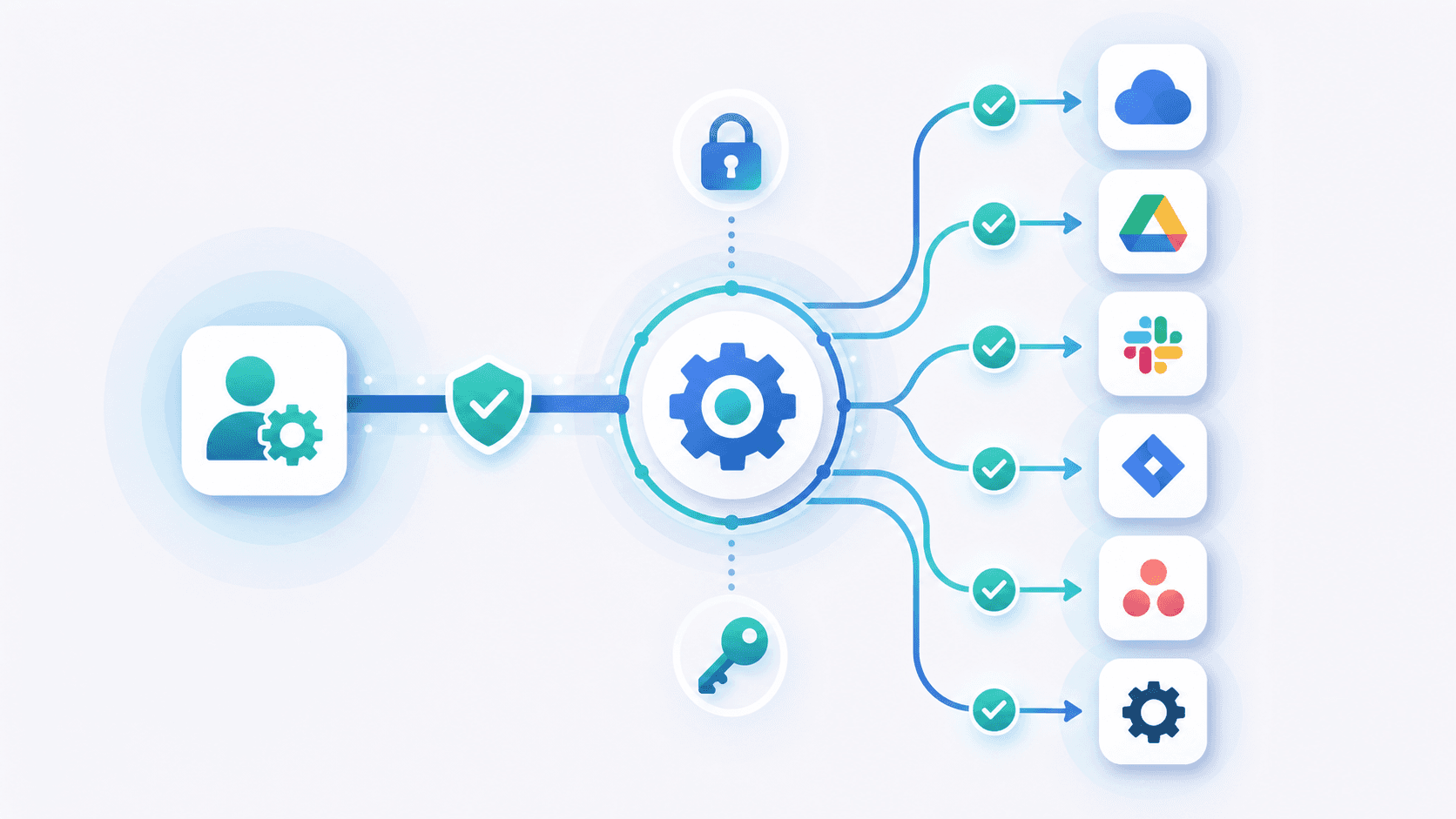
From our research and conversations with our own customers, the trigger and the checklist are the easy half. Creating and removing accounts across the whole stack is what eats up time.
Motion hit exactly this as it grew its contractor team (Motion customer story):
"We had just hired 10 offshore contractors to do support tickets for us, and each of those people needs 10 applications. I would have had to configure 100 applications."
Ethan Yu, Cofounder & COO, Motion
That manual work is what pushes teams to a tool that turns the HR event into real access. AccessOwl publishes its full integrations list so you can check your stack against it before you commit.
Method 2 - Automating SaaS onboarding & offboarding with BambooHR + AccessOwl
AccessOwl layers on top of BambooHR to handle SaaS onboarding, offboarding, and access controls.
The worfklow most teams want is simple: your HRIS (BambooHR), your IdP (Google or Microsoft), and your third-party apps all in sync. Access follows templates, not per-hire setup. Requests and approvals are centrally logged instead of scattered across tickets and spreadsheets.
AccessOwl is the layer that does that:
A start or end date in BambooHR triggers the whole workflow.
Access templates are matched to HR attributes (role, team, department, entity) and tweaked per person.
Requests and approvals happen in Slack or the dashboard, and employees self-serve.
Onboarding drops to minutes, and offboarding is one click or fully hands-off.
Every action is logged as it happens, so access reviews become evidence you already have.
You get one place to see who has access to what, including apps outside SSO or SCIM.
Shadow IT your HRIS and IdP never see gets surfaced.
What onboarding and offboarding looks like with BambooHR + AccessOwl
Onboarding, start to finish:
BambooHR says a support contractor starts Monday.
AccessOwl loads the template for that role: Slack, Zendesk, Google Workspace, and the internal support tool.
The relevant managers approve with one click in Slack.
AccessOwl provisions each app through its own integration, so no one opens an admin console. Every action is logged.
Offboarding runs in reverse. On the termination date in BambooHR, AccessOwl removes the person's licenses across their apps and reassigns owned assets to their manager. It also runs a free Shadow IT scan that catches apps IT never knew about, including free and password-based accounts outside SSO.
Leftover access is where risk concentrates, and there is more of it than teams expect. Microsoft reports that 80% of employees use non-sanctioned apps, and that IT admins guess 30 or 40 cloud apps in use when the real number is often over 1,000 (Microsoft).
The payoff shows up fastest on offboarding. FinCompare, a 50-person fintech, once let paid licenses run for months without anyone noticing (FinCompare story):
"Where an offboarding could take up to several hours per employee it can now be done with a single click."
Robert Pötzsch, Office Manager, FinCompare
What access review compliance looks like with BambooHR + AccessOwl
Because every grant, approval, and removal is logged, a SOC 2 or ISO 27001 access review becomes a report you pull, not a spreadsheet you build.
Instead of exporting a user list from each app, screenshotting the ones without an export, and pasting it all together, you have one record of who has access and how they got it. That takes a review from about 2 hours per app to about 10 minutes (SOC 2 access reviews).
How AccessOwl is different from BambooHR's native onboarding
The core difference is simple. Through its IdP link, BambooHR hands you the Microsoft or Google account and reminds a person to do the rest. AccessOwl creates the rest, across your whole stack, with no checklist handed to a human.
It provisions across 400+ apps without SCIM or SAML, including the long tail hidden behind enterprise plans. It works at the permission level, so a role change updates what someone can do, not just whether an account exists. It also surfaces Shadow IT and lets you customize a template per person.
What makes this work for a growing team is how AccessOwl connects: instead of SCIM or SAML, it uses admin-level service accounts and browser-based automation (how our provisioning works).
AccessOwl does not replace your IdP or handle logins, passwords, or MFA, and it does not manage devices. It sits on top of the Google Workspace or Microsoft 365 you run and automates the access lifecycle, keeping your HRIS, IdP, and apps in sync.
How AccessOwl integrates with BambooHR (and Google Workspace or Microsoft 365)
BambooHR stays your source of truth for joiners and leavers. AccessOwl reads those events and works alongside your existing Google Workspace or Microsoft 365, and Okta if you run it. It integrates with BambooHR so the HR event is what starts the work.
Who this is best for
AccessOwl plus BambooHR fits a growing team (30+ people) on BambooHR with third-party apps beyond what login-based SSO reaches. You might have a small IT team owning provisioning, or this might sit with a non-technical operations person.
Method 3 - SaaS provisioning with BambooHR + DIY automation
The third route is to wire it up yourself. A technical person can trigger automation off BambooHR's webhooks with Zapier or Make, script against the API, or lean on PowerShell for Microsoft and GAM for Google. Under about 30 people or 5 apps, with someone who owns it, this holds up fine.
It frays as you grow. The scripts cover the apps someone remembered to wire, so a leaver keeps access to the one that got missed, and no one notices until an audit asks. There is no approval step, no self-serve, and no record of who granted what.
Then an app changes its API and the automation quietly breaks. Shadow IT never surfaces at all. And the whole thing lives in one person's head, so when they leave, the only map of how access works leaves with them.
Which method is right for you?
BambooHR native (HR + IdP sync) | BambooHR + AccessOwl | BambooHR + DIY | |
|---|---|---|---|
App provisioning coverage | Microsoft/Google account via your IdP; a checklist reminds a human for the rest | 400+ apps, no SCIM required | Whatever you build and maintain |
Permission depth | Holds role and team data; no in-app permission action beyond the IdP account | Account and in-app permissions, per person | Depends on the script |
Offboarding completeness | Microsoft/Google account off; the rest is a checklist, manual per app | Full stack of third-party apps, incl. Shadow IT | Only what is scripted |
Shadow IT discovery | No | Yes | No |
Audit evidence | Manual | Logged end to end | Manual |
Access permission templates | Checklist templates only | Yes | No |
Cost | Included in BambooHR (HR + IdP sync) | See our plans | Tooling plus engineering time |
AccessOwl is not an identity provider and does not handle logins, passwords, MFA, or devices. It layers on top of the Google Workspace or Microsoft 365 you already run and automates the access lifecycle. BambooHR stays your HR system, and this comparison is only about SaaS access.
FAQs
Does BambooHR offer features to automate provisioning of SaaS apps to automate onboarding and offboarding?
Not for the full stack. BambooHR automates the HR side and, through your IdP, switches the Microsoft or Google account on and off. It does not create or delete accounts in your other SaaS apps. To automate that, you connect a dedicated tool. AccessOwl reads BambooHR's start and end dates and provisions across 400+ apps, without SCIM or SAML.
Does BambooHR have an IT module or native features for provisioning apps (creating, deleting, and adjusting permissions in accounts)?
No. BambooHR has no dedicated IT or access-management module. Its access levels control who can see and edit records inside BambooHR, not access in your third-party apps. Provisioning to apps happens through your IdP (the Microsoft or Google account) or a lifecycle tool like AccessOwl (the rest of the stack, including in-app permissions).
If I'm using BambooHR, why use AccessOwl over Okta?
Okta Workforce Identity Cloud is right for some teams: large or regulated companies with a dedicated identity team and a multi-IdP setup. For a growing company on BambooHR, it is usually more platform than you need, and it carries the SSO tax.
If you already run Okta, AccessOwl layers on top and adds app coverage and lifecycle automation without ripping anything out. If you have not rolled it out, AccessOwl gives you the onboarding, offboarding, and access control you were after for a fraction of the cost, live in days.
Can BambooHR automatically create and delete SaaS accounts in Google Workspace or Microsoft 365?
Through your IdP, the Microsoft or Google account can be activated and deactivated from BambooHR's start and end dates. But even at the IdP, automated provisioning is capped by plan.
Google offers SSO for over 200 apps but automated provisioning for far fewer: up to 100 on paid editions, and 3 on the entry tier (Google admin docs). Beyond that account layer, BambooHR does not reach your apps. AccessOwl provisions across 400+ apps without SCIM.
Our team uses BambooHR, how do I make sure all app access is revoked when an employee leaves?
BambooHR flags the departure and, through your IdP, shuts off the Microsoft or Google account. It does not remove access in your other apps. AccessOwl uses the termination date in BambooHR to remove licenses across every connected app, reassign owned assets to the manager, and surface Shadow IT accounts your HRIS never saw. Offboarding is complete and logged.
Can I use role, team, or department from BambooHR to decide app access automatically during onboarding?
Yes. BambooHR holds each person's role, team, department, location, and entity. AccessOwl maps access to those attributes and lets you customize per person, so a support contractor on a given team gets exactly the right apps and permissions on day one.
What are the best tools that integrate with BambooHR to provision accounts automatically for onboarding and offboarding?
The category is IGA and lifecycle automation that plugs into BambooHR as the HR source of truth. AccessOwl is built for this: it reads BambooHR's joiner and leaver events and provisions across 400+ apps, including the ones outside SSO and SCIM.