
You're researching identity automation and every search result assumes you already know what SCIM is, what SCIM provisioning does, how SCIM works in Azure versus Okta, what SCIM integration requires, whether SCIM authentication is separate from SCIM SSO, how the SCIM API and SCIM protocol relate, what SCIM stands for, what a SCIM token does, how to set up Okta SCIM provisioning or Microsoft Entra ID SCIM, what SCIM user provisioning means in identity management, and how SCIM compares to SAML or SSO. Maybe you're also seeing terms like SCIM bridge, SCIM server, SCIM RFC, and wondering what a SCIM weapon even is in this context.
SCIM (System for Cross-domain Identity Management) is the protocol that's supposed to let your identity provider automatically create, update, and remove user accounts across every app in your stack. In reality, it only works where vendors build a SCIM endpoint and where you're willing to pay enterprise-tier pricing to unlock it. Most teams end up with partial automation at best. Here's how the SCIM protocol actually functions, where it helps, and where you'll still be manually provisioning accounts no matter how much you spend.
TLDR:
SCIM automates user provisioning across apps, but most vendors lock it behind enterprise plans that cost 3x-10x more per app.
SCIM only covers 15-25% of your stack; it creates accounts but won't assign granular permissions like Slack channels or Jira roles.
SCIM and SSO solve different problems: SCIM provisions accounts, SAML/SSO handles authentication at login.
Google Workspace SCIM support is limited with no automatic group provisioning; Okta and Entra ID cover more apps but still leave gaps.
AccessOwl provisions across 400+ apps using OAuth, APIs, and RPA without requiring enterprise upgrades or SCIM endpoints.
What SCIM Is and Why It Exists
System for Cross-domain Identity Management (SCIM) is an open standard protocol designed to automate how user identity data moves between an identity provider (IdP) and the cloud applications your team uses every day. When someone joins, changes roles, or leaves, SCIM handles creating, updating, and removing their accounts across connected apps without anyone touching a spreadsheet or logging into each tool manually.
Why does that matter? Because the average tech company now runs over 106 SaaS services. Nobody is hand-provisioning accounts across that many apps and keeping them accurate. Before SCIM, IT teams cobbled together CSV imports, custom scripts, and a lot of hope. SCIM gave the industry a shared language for moving user data between systems so that provisioning and deprovisioning could actually be automated at scale.
The SCIM Protocol: RFC Standards and Technical Foundation
SCIM 2.0 is the current version of the protocol, published in September 2015 by the IETF across three RFCs. RFC 7643 defines the core schema, including how user and group objects are structured. RFC 7644 specifies the protocol itself, and RFC 7642 documents the use cases that motivated the design.
Under the hood, SCIM is a RESTful API. It uses JSON payloads and standard HTTP methods (POST to create, GET to read, PUT/PATCH to update, DELETE to remove) for CRUD operations on identity resources. If you've built or consumed any REST API, the mechanics will feel familiar. That simplicity is intentional: SCIM was designed so vendors could implement it without building a bespoke integration layer for every identity provider.
How SCIM Provisioning Actually Works
SCIM follows a client-server model. Your identity provider (Okta, Microsoft Entra, Google Workspace) acts as the SCIM client, and each connected SaaS app runs a SCIM server endpoint. The IdP initiates every request; the app receives and executes it.
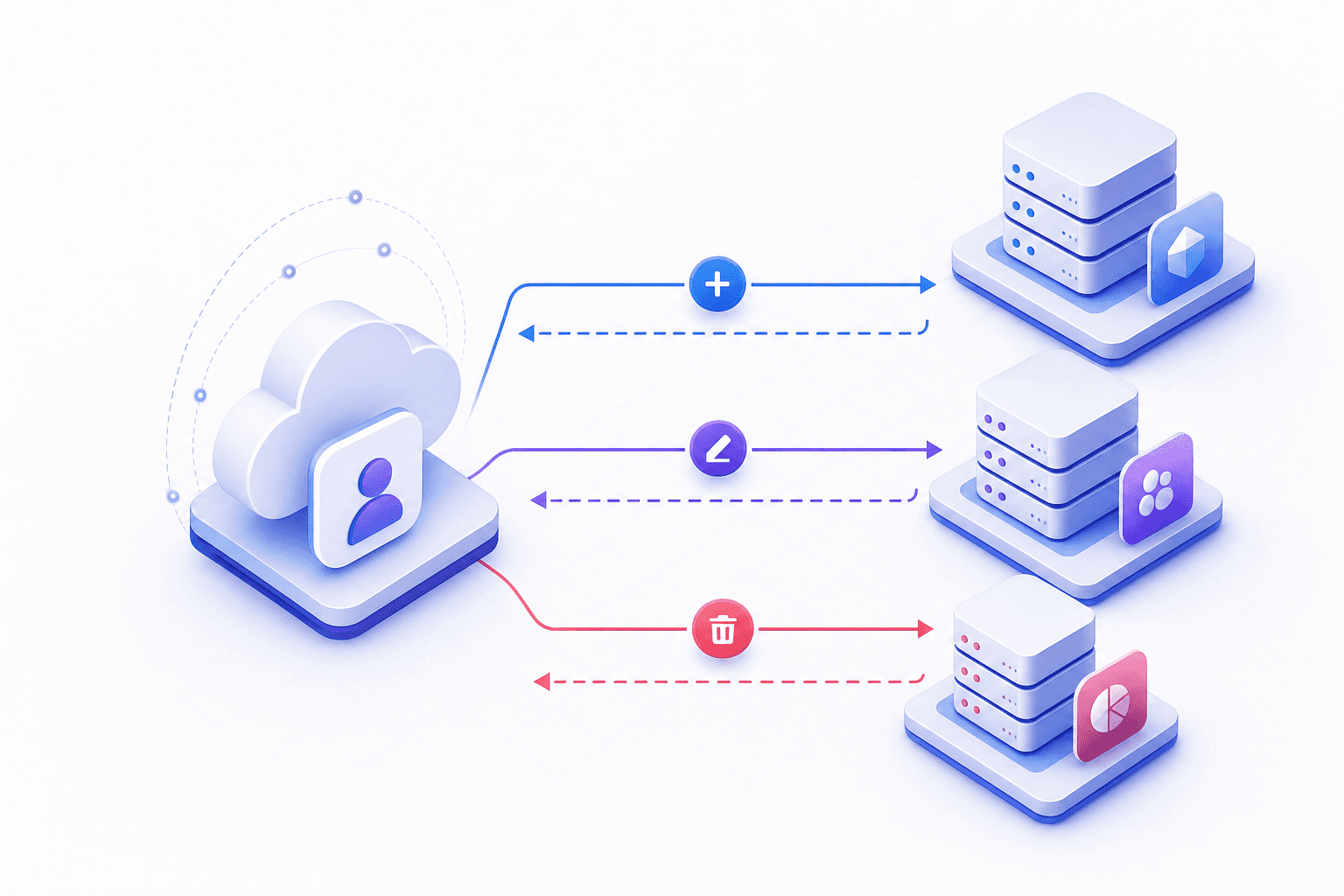
Here's what that looks like in practice:
When a new hire is added to the IdP, the client sends a POST to the app's
/Usersendpoint with attributes like name, email, and department. The app creates the account and returns a unique resource ID.If that employee switches teams, the IdP pushes a PATCH with the updated attributes. The app syncs the change.
When someone leaves and their IdP account is deactivated, the client sends a PATCH setting
activetofalse(or, less commonly, a DELETE). The app disables or removes the account.
Every step is triggered from the IdP side. The SaaS app never polls for changes; it responds to inbound requests and confirms the result.
Common SCIM Use Cases
Most teams encounter SCIM first when connecting their IdP to a handful of core SaaS apps like Slack, GitHub, or Salesforce. But the protocol shows up in a few other scenarios worth knowing:
SaaS application integration is the most common case. Automate account creation and removal across cloud tools as people join or leave.
Mergers and acquisitions. When two companies merge identity directories, SCIM can sync user data between previously separate systems without rebuilding accounts from scratch.
Contractor and partner access. For external collaborators who need time-limited accounts, SCIM lets you provision and deprovision on a schedule tied to contract dates.
Hybrid cloud environments. Organizations running a mix of on-prem and cloud services use SCIM to keep identity data consistent across both, though implementation complexity rises quickly in these setups.
If your situation maps to any of these, SCIM is probably already part of the conversation with your IdP vendor.
SCIM vs SAML: Provisioning vs Authentication
SCIM and SAML solve different problems. SCIM handles provisioning: creating, updating, and removing user accounts across applications. SAML (Security Assertion Markup Language) handles authentication: verifying a user's identity so they can log in via single sign-on. One sets up the account; the other opens the door.
SCIM | SAML | |
|---|---|---|
Purpose | Account provisioning and lifecycle sync | Authentication and SSO |
When it runs | Continuously, syncing identity data in the background | Only during login events |
What it manages | User attributes, group memberships, account status | Identity assertions and session tokens |
They're complementary, and in most setups you'll see both working side by side. SCIM keeps account data in sync between your IdP (Identity Provider) and each app, while SAML kicks in only when someone actually needs to authenticate. Neither replaces the other, and deploying SAML without SCIM still leaves you provisioning accounts by hand.
SCIM vs SSO: Account Lifecycle vs Login Experience
SSO gives your team one set of credentials to log into multiple apps. SCIM decides whether those accounts exist in the first place. They operate on different planes: SSO handles the login experience, while SCIM manages the full account lifecycle, from creation through updates to deactivation.
If you deploy SSO without SCIM, someone still has to manually create each account before a user can authenticate against it. SSO won't provision, update roles, or revoke access when someone leaves. Most organizations need both working together.
The SSO Tax and SCIM Pricing Reality
SCIM is a free, open protocol, but most SaaS vendors lock it behind enterprise-tier plans. The industry calls this the SSO tax. Upgrades can inflate per-app costs by 3-10x just to unlock provisioning. When paying enterprise rates across your whole stack is unrealistic, SCIM coverage tops out around 15-25% of your apps. The rest stays manual.
The Coverage Gap: Why SCIM Doesn't Reach Your Whole Stack
Even when the budget is there, plenty of SaaS vendors simply don't implement SCIM. Smaller tools, vertical apps, and niche internal products often ship no provisioning API at all. You can't automate what doesn't exist on the other end.
Google Workspace compounds the problem. Google Workspace SCIM support covers a small, mostly static list of apps with no automatic group provisioning, a real limitation given how many companies rely on Google as their primary IdP (Identity Provider). Okta and Microsoft Entra ID offer broader SCIM app catalogs, but even those leave a long tail of unsupported tools that somebody has to provision by hand.
SCIM Implementation Challenges and Limitations
Even when a SaaS app supports SCIM, implementation rarely goes smoothly. IdPs interpret the spec differently, so attribute mappings that work in Okta may break in Entra ID. You end up debugging mismatches between what the IdP sends and what the app expects, often with limited error logging on either side.
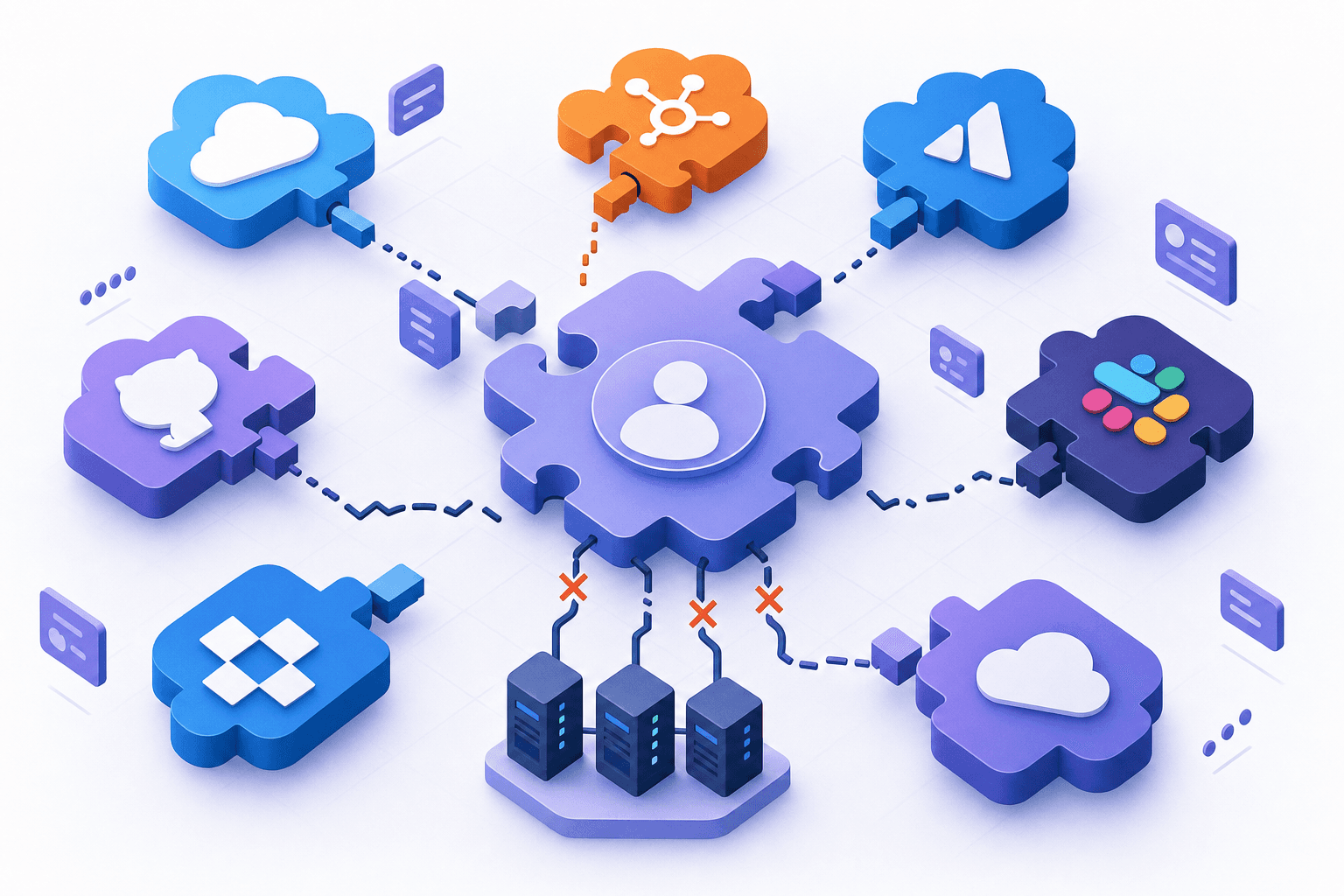
Then there's the depth problem. SCIM creates an account, but it won't add a user to specific Slack channels, assign Jira project roles, or attach AWS IAM policies. That granular permission work still falls on someone manually. The account exists; it's not usable yet.
Getting any of this right typically requires an identity specialist, the kind of hire a 100-person company can't afford and a first-time IT admin shouldn't be expected to become overnight.
Alternatives to SCIM for Automated Provisioning
When SCIM isn't an option, three approaches fill the gap:
Service-account-based browser automation. RPA tools provision users through the same admin interfaces IT already uses, no SCIM endpoint needed.
Direct vendor APIs on standard-tier plans. Many apps expose user-management endpoints outside SCIM. Each integration is bespoke, but the pricing barrier drops compared to upgrading every app to enterprise.
Manual ticketing routed to tool owners. For apps with no API at all, you forward the task, track completion, and keep an audit trail.
None of these give you a single standard the way SCIM does. But they reach the apps SCIM never will.
How AccessOwl Solves the SCIM Coverage Problem
We built AccessOwl around the gaps outlined above. Instead of relying on SCIM endpoints, AccessOwl connects to 400+ apps through OAuth, direct APIs, and RPA on whatever plan you already pay for. No enterprise upgrades, no SSO tax.
That means full permission assignment, not skeleton accounts. Slack channels, GitHub repos, Jira project roles, all provisioned automatically. Google Workspace works without the SCIM limitations we covered earlier.
Offboarding goes deeper too: license are removed, assets are reassigned to managers, and Shadow IT accounts are included in the workflow. SCIM can't do any of that on its own.
Final Thoughts on SCIM and What It Doesn't Cover
SCIM is a solid protocol when vendors implement it and when you can afford to unlock it across your stack. But gaps are normal at your scale. If you're provisioning manually across most of your apps and looking for a way to automate without enterprise plans, book 30 minutes with us and we'll walk you through how AccessOwl fills in what SCIM leaves out.
FAQ
What does SCIM stand for and what is it used for?
SCIM stands for System for Cross-domain Identity Management, and it's an open protocol that automates how user data moves between your identity provider and SaaS applications. It handles account creation, updates, and removal across connected apps when employees join, change roles, or leave, replacing manual provisioning across each tool.
SCIM vs SAML for user provisioning?
SCIM handles provisioning (creating and removing accounts), while SAML handles authentication (logging in via SSO). SCIM runs continuously in the background to keep account data in sync, but SAML only kicks in during login events. You need both working together. SAML won't create accounts, and deploying SSO without SCIM still leaves you provisioning by hand.
Can I use SCIM provisioning without upgrading to enterprise SaaS plans?
No, most SaaS vendors lock SCIM behind enterprise-tier plans as part of the SSO tax. These upgrades can inflate per-app costs by 3 to 10x just to unlock provisioning, which is why SCIM coverage typically tops out around 15 to 25% of your stack. Service-account-based automation through direct APIs and RPA reaches apps on standard plans without the enterprise upgrade cost.
What is the difference between SCIM and SSO?
SSO provides one set of credentials to log into multiple apps, while SCIM decides whether those accounts exist in the first place. SSO handles the login experience; SCIM manages the full account lifecycle from creation through deactivation. If you deploy SSO without SCIM, someone still has to manually create each account before a user can authenticate.
How does SCIM work with Okta and Microsoft Entra ID?
In SCIM provisioning, your IdP (Okta, Microsoft Entra, or Google Workspace) acts as the SCIM client and initiates all requests. Each connected SaaS app runs a SCIM server endpoint that receives and executes those requests: creating accounts via POST, updating attributes with PATCH, and disabling accounts when employees leave. The IdP triggers every action; apps never poll for changes.
Do SCIM implementations work the same way across all SaaS apps?
No. While SCIM 2.0 is a standard protocol, vendors implement it with different levels of completeness. Some apps only support organizational roles but not team or channel assignments, others can't fully remove accounts or release licenses through SCIM, and attribute mappings that work in one IdP often break in another. You'll debug these gaps app by app.106 SaaS services