

Most access management tools solve SOC 2 compliance by making you upgrade your entire SaaS stack to enterprise pricing tiers just to support SCIM and SAML integrations. If you're a Series A to Series C company with 40+ applications and one IT hire, that approach breaks your budget before it solves your audit problem. We tested access management tools for SOC 2 to identify which ones automate the full access lifecycle across your actual SaaS environment, including the long tail of smaller apps your vendors want you to pay more for.
TLDR:
Access management tools automate provisioning, approvals, and reviews to meet SOC 2 requirements
Most tools require SCIM/SAML, forcing expensive SaaS upgrades across your entire stack
Access reviews should remediate issues immediately, not weeks after discovery
Shadow IT detection surfaces unauthorized apps that create compliance blind spots
AccessOwl automates access governance without enterprise prerequisites or long deployments
What Are Access Management Tools for SOC 2 Compliance?
Access management tools for SOC 2 compliance help you govern, automate, and audit user interactions with your SaaS applications. They exist to answer what your auditor will ask: who has access to what, and can you prove it? SOC 2 examinations focus on controls relevant to security, availability, and confidentiality. Your organization needs to show evidence of:
Role-based access controls that match job functions to appropriate permission levels across every application in your stack
Formal provisioning and deprovisioning tied to the employee lifecycle, from day-one onboarding through offboarding
Periodic access reviews to verify that permissions are still appropriate and haven't drifted over time
Approval workflows with a clear audit trail showing who requested access, who approved it, and when
Timely revocation when someone changes roles or leaves the company, with documented proof of removal
For a Series A or Series B company with a small IT team, managing this in spreadsheets gets painful fast. The best access management tools handle the full governance lifecycle: detecting Shadow IT, automating account creation and removal, routing approval requests, and generating compliance evidence without manual effort.
If you can't show an auditor a clean trail from access request to approval to periodic review, your SOC 2 readiness has a gap, no matter how good your security posture looks on paper.
How We Ranked These Access Management Tools
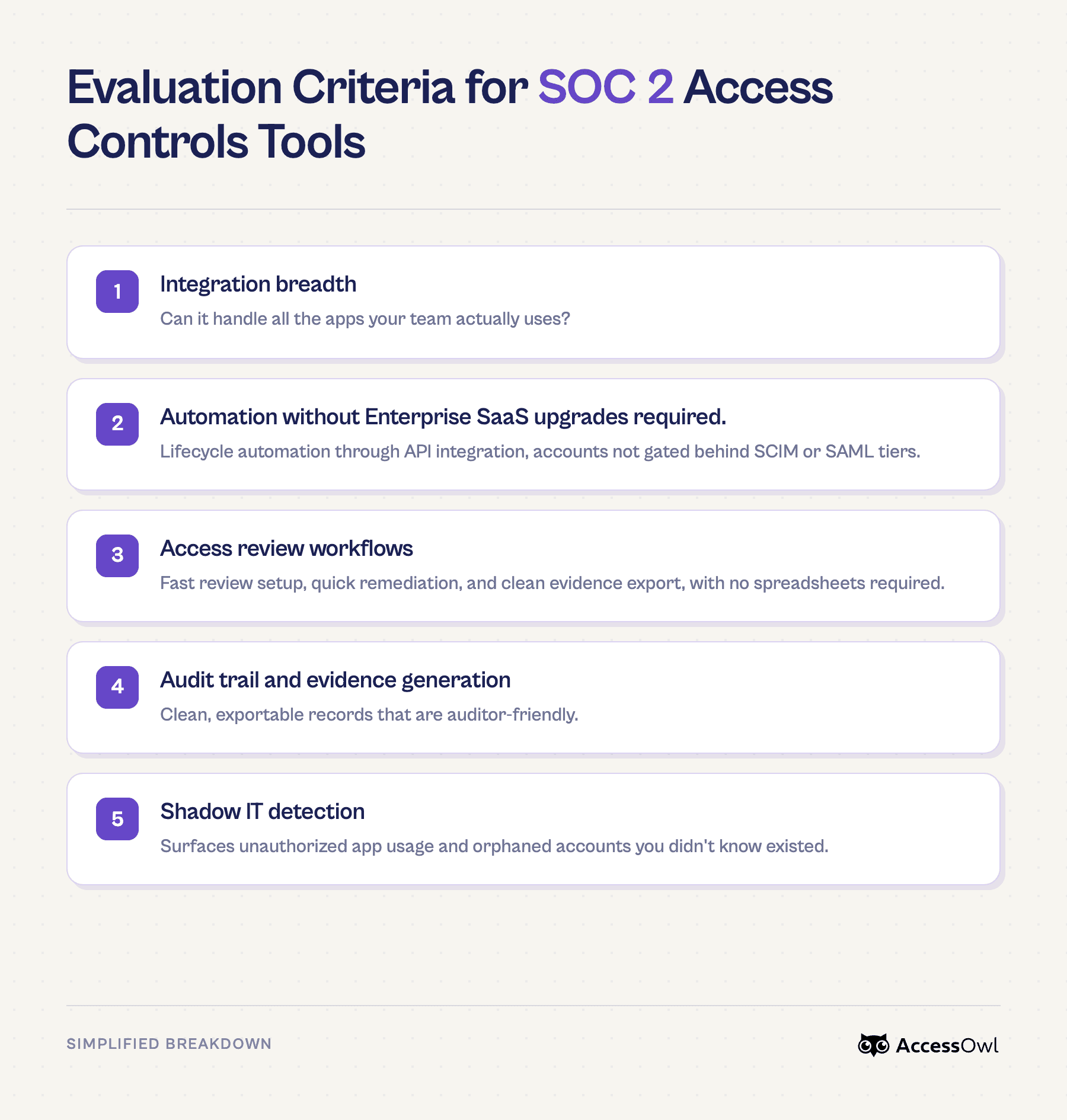
We built our evaluation criteria around the reality most Series A to Series C companies face: lean teams, tight timelines, and auditors who won't care about your resource constraints. Here's what we weighted:
Integration breadth: Can it handle apps your team actually uses beyond the big-name ones?
Automation without enterprise prerequisites: Many tools require SCIM or SAML, which are locked behind expensive enterprise tiers. We favored tools that automate lifecycle management through APIs, service accounts, or RPA.
Access review workflows: We tested review setup, remediation speed, and evidence export. Tools requiring spreadsheets scored lower.
Audit trail and evidence generation: Clean, exportable records with integration to Vanta or Drata.
Deployment speed: Tools that go live in days, not weeks.
Pricing transparency: We noted which vendors hide costs behind sales calls.
Shadow IT detection: Orphaned accounts in apps you don't know about are a compliance blind spot. Tools that surface unauthorized application usage scored higher.
Best Overall Access Management Tool for SOC 2 Compliance: AccessOwl
AccessOwl is an access governance and SaaS management tool built for growing companies that need to automate provisioning, access requests, approvals, access reviews, and Shadow IT detection to meet SOC 2 requirements. It deploys in days, not weeks, and the primary interface is Slack, so your team adopts it without learning another dashboard.
What AccessOwl Offers
Automated provisioning and deprovisioning across 400+ SaaS applications without requiring SCIM or SAML, which means you're not forced into expensive vendor tiers just to automate account lifecycle management
Built-in access review workflows with automatic remediation designed for SOC 2 and ISO 27001 compliance, including time estimates so managers can plan their review sessions
Shadow IT discovery through OAuth log analysis from Google Workspace or Microsoft 365, surfacing apps your employees are using that never went through procurement
Complete audit trails and evidence collection for compliance reporting, with export capabilities to tools like Vanta
HRIS integration for automated onboarding and offboarding workflows triggered by employee start and end dates, removing manual steps from day one
Why AccessOwl Works for SOC 2
The access review process is where most small IT teams lose weeks of productivity. With AccessOwl, managers receive Slack notifications, review their direct reports' access in minutes, and any revocations or modifications take effect immediately. There's no lag between identifying a problem and fixing it, which is exactly the kind of gap auditors love to flag. Recurring access reviews should happen at regular intervals: quarterly or annually at minimum, but the remediation shouldn't wait weeks after discovery.
For Series A to Series C companies, the integration approach matters. Most provisioning tools rely on SCIM or SAML connections, but those protocols are frequently gated behind enterprise pricing from your SaaS vendors. AccessOwl uses a mix of service accounts, direct API connections, and RPA to automate account lifecycle management across all vendor tiers. You shouldn't have to upgrade to Jira Enterprise just to automate offboarding.
Shadow IT detection rounds out the compliance picture. By reading OAuth sign-in logs from your identity provider, AccessOwl automatically surfaces unknown applications and integrates them into offboarding workflows. No orphaned accounts slip through during an audit.
If you're the first IT hire and need access governance in place before your next SOC 2 audit window, AccessOwl provides the automation layer to handle it without building a team around the problem. Install the Slack app, connect your HRIS and identity provider, and you're up and running.
In this article we broke down how we automate every step of the SOC 2 review process at our own company using AccessOwl.
Okta Identity Governance
Okta Identity Governance is an add-on governance layer for organizations already invested in the Okta ecosystem. It extends Okta's authentication capabilities into access approvals, reviews, entitlements, and compliance workflows. If your company already runs Okta as its primary identity provider, this feels like the natural next step for SOC 2 access governance. But "natural" and "practical" aren't always the same thing.
What They Offer
Access request and approval workflows integrated natively with Okta, so governance lives inside the same console your IT team already uses daily
Periodic access certification campaigns designed for access controls, with scheduled review cycles and sign-off tracking
Entitlement management and separation of duties controls that map user permissions against policy rules
Integration with applications already connected to Okta via SCIM and SAML, keeping governance within the existing identity fabric
For organizations that have near-complete Okta SSO coverage across their SaaS stack, broad SCIM and SAML integrations already in place, and a dedicated IT team to support longer implementation timelines, Okta Identity Governance can consolidate governance within a single vendor.
Where It Falls Short
The catch is the prerequisite investment. Okta Identity Governance only works well when companies have already upgraded most SaaS applications to enterprise plans that support SCIM and SAML. Applications outside Okta remain entirely outside the governance workflow, which fragments your access management picture. During rollout, many companies find that a surprising number of their critical apps lack the required integrations unless they spend considerably more on SaaS tier upgrades across their entire stack. This is the "SSO tax" in action, and it compounds fast.
If you're a 60-person Series B company running a mix of free-tier, pro, and business-tier SaaS subscriptions, you'll likely hit coverage gaps that leave blind spots in your compliance posture. Those gaps are exactly what auditors will question.
Okta Identity Governance makes sense for enterprises already locked into the Okta ecosystem with complete SCIM coverage. For teams that need broad access governance across their actual SaaS environment without first upgrading every application to an enterprise tier, the prerequisites here can become a blocker instead of a shortcut.
Corma
Corma started as a SaaS spend management and license optimization tool, then added access management features to broaden its market. The core of the product remains finance-driven: cost visibility, license reclamation, and vendor renewal tracking. If your CFO is the one pushing for tooling, Corma might land on the shortlist. But if you're the IT manager trying to pass a SOC 2 audit, the story gets more complicated.
What They Offer
SaaS spend visibility and license optimization across your application portfolio, giving finance teams a clear picture of where budget is going
Shadow IT discovery through a browser extension that tracks which apps employees are actually using, surfacing unauthorized tools before they become audit liabilities
Basic access request workflows for routing provisioning tasks through predefined channels
Vendor and renewal management to consolidate contract timelines and reduce redundant subscriptions
Corma works well for finance-led initiatives where the primary goal is cutting SaaS costs and reclaiming unused licenses, with access governance treated as a secondary benefit.
Where It Falls Short
The access management layer is thin relative to purpose-built governance tools. Integration coverage skews toward standard identity provider patterns instead of deep, application-specific automation. In practice, provisioning and deprovisioning for many of your critical apps still requires manual intervention. If you're managing 40+ SaaS tools and expecting automated account lifecycle management across all of them, you'll find gaps quickly.
Corma excels at telling you how much you're spending and where licenses sit idle. What it doesn't do well is automate the workflows that SOC 2 auditors actually care about: structured approval chains, periodic access reviews with immediate remediation, and clear evidence export. The product solves a spend problem first and treats governance as a bolt-on.
For a Series A to Series C IT manager, this ordering matters. If your next audit is in three months and you need access reviews, automated deprovisioning, and a full audit trail, a tool optimized for license reclamation won't close those gaps. Corma is a solid pick when finance is the buyer and cost reduction is the mandate, but less so when your primary driver is passing a SOC 2 audit with minimal manual effort.
SailPoint
SailPoint is a long-standing name in Identity Governance and Administration (IGA), serving large enterprises in compliance-heavy industries. That reputation is earned, but it comes with a specific buyer profile.
What They Offer
Access certification campaigns with configurable review cycles, reviewer delegation, and policy-based sign-off workflows designed for SOC 2, ISO 27001, and other regulatory frameworks
Role mining and role management capabilities that analyze existing access patterns and suggest role definitions, reducing permission sprawl over time
Separation of duties (SoD) policy enforcement to flag and prevent toxic access combinations before they create compliance violations
Deep integration with on-premise infrastructure, including Active Directory, mainframes, and legacy systems that cloud-native tools rarely touch
AI-driven access recommendations that suggest whether reviewers should approve or revoke specific entitlements based on peer group analysis
Where It Falls Short
SailPoint was built for thousands of employees with dedicated identity teams. Deployments take months and often require consultants. Pricing isn't public, and contracts start well above what sub-200-person companies budget. For a Series B company with one IT hire who needs to pass a SOC 2 audit next quarter, the timeline and cost don't align with your scale.
Why It Works for Large Organizations
SailPoint applies AI to detect anomalous access and privilege creep across thousands of identities. The entitlement layer enforces fine-grained permissions across cloud and on-premise systems. Connectors span Active Directory, SAP, Oracle, ServiceNow, mainframes, and hundreds of SaaS apps.
SailPoint fits enterprises with mature identity programs, dedicated teams, and six-figure budgets. But for 50 to 200-person companies needing governance before their next audit, the complexity and cost work against you. AccessOwl provides the automation growing companies need without enterprise overhead or six-figure pricing.
Entitle
Entitle focuses on reducing standing access with temporary, time-bound permissions that expire automatically. Now part of BeyondTrust, it's built around just-in-time (JIT) access. If your security model leans toward least-privilege in cloud infrastructure, Entitle fits.
What They Offer
Automated provisioning workflows and self-serve access requests across 150+ integrations, letting engineers request what they need without filing tickets
Just-in-time access with time-bound permissions that automatically revoke when the window closes, reducing the surface area of standing privileges
Integration with on-call tools like PagerDuty for emergency access scenarios, so engineers on rotation can get higher permissions without waiting for manual approvals
Cloud infrastructure entitlement management (CIEM) capabilities that map and monitor permissions across AWS, GCP, and Azure environments
Where It Falls Short
The JIT model assumes security maturity that most Series A to Series C companies haven't reached. When passing a SOC 2 audit is your goal, you need onboarding automation, access reviews with evidence export, and HRIS-tied lifecycle management. For IT managers responsible for 40+ SaaS applications, that gap matters during audit prep.
Entitle excels at cloud privilege management. For broader SaaS governance, HRIS-driven automation, and compliance-ready workflows covering your entire stack, AccessOwl delivers without requiring cloud-native security maturity first.
ConductorOne
ConductorOne is built for companies that have already invested heavily in identity infrastructure. It assumes you've deployed SCIM and SAML across most of your SaaS stack before you start.
What They Offer
Access request workflows with policy-driven approval chains that route requests based on application sensitivity and organizational hierarchy
Automated access certification campaigns designed for SOC 2 and ISO 27001 audit cycles, with reviewer tracking and sign-off workflows
Native integration with Okta and other identity providers, pulling entitlement data from connected applications into a centralized governance view
Entitlement management for complex permission structures, including visibility into granular roles and group memberships across connected systems
Where It Falls Short
ConductorOne requires SCIM and SAML, meaning enterprise-tier upgrades are required before governance becomes useful. For a 75-person Series B running mixed subscription tiers, that spend adds up. Implementation takes months because the value depends on the identity provider's coverage. Pricing skews toward the enterprise, with contracts starting above what sub-150-employee companies' budgets allow.
If you've built identity foundations and need formal governance, ConductorOne is a good fit. But if you're still solving basics like provisioning and access reviews, you need a tool that doesn't require identity architecture expertise or enterprise pricing across your stack.
Feature Comparison Table of Access Management Tools for SOC 2 Compliance
Feature | AccessOwl | Okta Identity Governance | Corma | SailPoint | Entitle | ConductorOne |
|---|---|---|---|---|---|---|
Works Without SCIM/SAML | Yes | No | No | No | No | No |
Automated Access Reviews | Yes | Yes | No | Yes | No | Yes |
Shadow IT Discovery | Yes | No | Yes | No | No | No |
Deployment Time | Days | Months | Weeks | Months | Weeks | Months |
HRIS Integration | Yes | Yes | No | Yes | No | Yes |
Viable Under 100 Employees | Yes | No | Yes | No | No | No |
Purpose-Built for Access Governance | Yes | Yes | No | Yes | No | Yes |
Only AccessOwl automates provisioning without SCIM or SAML, removing the cost of upgrading every app to enterprise tiers. When reviewers flag inappropriate access, AccessOwl revokes it immediately. Every other tool introduces lag. If you're under 100 employees, most tools require dedicated identity teams and six-figure budgets. AccessOwl was purpose-built for access governance at growing companies with lean IT teams.
Why AccessOwl Is the Best Access Management Tool for SOC 2 Compliance
Every tool on this list solves a piece of the access governance puzzle. But when you're the sole IT hire at a growing company and your SOC 2 audit is approaching, you need something that covers the full scope without forcing you to rebuild your infrastructure first.
That's where we fit. AccessOwl connects to 400+ SaaS applications via service accounts, direct APIs, and RPA, helping automated provisioning and deprovisioning regardless of the pricing tier your vendors have you on. No SCIM prerequisite. No SAML tax. No upgrading Jira or Slack to enterprise plans just so your governance tool can talk to them.
Access reviews are the other half of the equation. Auditors want evidence that you're periodically reviewing who has access to what and acting on the results. With AccessOwl, managers receive a Slack notification, review their direct reports' access in minutes, and any revocation takes effect immediately. The gap between "we found a problem" and "we fixed it" shrinks to zero, which is exactly the story your auditor wants to hear.
Because we pull OAuth sign-in logs from your identity provider, Shadow IT doesn't slip through the cracks during offboarding. Every account gets caught, managed or not.
If you're preparing for your first SOC 2 audit and you need access governance running this quarter, not next year, AccessOwl gets you there without the enterprise overhead.
Final Thoughts on Access Management for SOC 2 Audits
When you're comparing access management tools for SOC 2, the real question is whether the tool matches your current reality or forces you to build enterprise infrastructure first. Most vendors assume you have unlimited time and budget to upgrade every SaaS app to an enterprise tier, but that's not where Series A to Series C companies actually operate. You need automated provisioning, access reviews with immediate remediation, and Shadow IT detection that works across your actual app portfolio without requiring months of professional services. Check which apps are creating compliance gaps in your environment right now. Your auditor won't care about your resource constraints, so choose a tool that closes the gaps you have today instead of the ones a Fortune 500 company faces.
FAQs
How do I choose the right access management tool for SOC 2 compliance if I have fewer than 100 employees?
Your company size limits your options more than you'd expect. Most tools on the market were built for enterprises and require SCIM/SAML integration, dedicated identity teams, and six-figure budgets. Look for a tool that works without forcing you to upgrade every SaaS app to an enterprise tier first, deploys in days instead of months, and handles the full lifecycle from onboarding through access reviews with immediate remediation.
Which SOC 2 access management tool works best if I don't have SCIM or SAML set up across my SaaS stack?
AccessOwl is the only tool that automates provisioning and deprovisioning without requiring SCIM or SAML prerequisites. The other options assume you've already upgraded most of your applications to enterprise plans that support those protocols, which adds substantial cost before you even start the governance work.
What's the difference between access management tools built for finance teams versus IT teams?
Finance-focused tools like Corma focus on spend visibility, license optimization, and vendor management, with access governance layered on as a secondary feature. IT-focused tools like AccessOwl, Okta Identity Governance, and SailPoint treat access governance as the core function, with deeper automation for provisioning, access reviews, and audit evidence. If passing a SOC 2 audit is your primary goal, an IT-focused tool will close more compliance gaps.
When should I consider an enterprise-grade tool like SailPoint for SOC 2 instead of a lighter option?
SailPoint makes sense when you're managing thousands of employees, running complex hybrid environments with considerable on-premise infrastructure, operating under multiple regulatory frameworks simultaneously, and have a dedicated identity security team with a budget exceeding six figures annually. If you're a sub-200-person company with one IT hire, the implementation timeline and cost structure work against you.
How is an access management tool like AccessOwl different from Vanta or Drata?
Vanta and Drata are broad compliance platforms. They do monitor your controls, flag gaps, and collect evidence for your SOC 2 audit, but they don't provision accounts, run the access reviews, or revoke access for you. AccessOwl does. It routes access reviews to the right reviewer, executes the remediation action with one click, and exports clean evidence. Most compliant teams will layer AccessOwl on top of a platform like Vanta or Drata to further automate manual processes.